Seasonal Business Cycles: Matching IT Investment to Growth Patterns
Posted by K. Brown March 23rd, 2026
Seasonal Business Cycles: Matching IT Investment to Growth Patterns
By Tom Glover, Chief Revenue Officer at Responsive Technology Partners
The accounting firm’s managing partner called me in mid-March, frustrated and exhausted. They’d decided to migrate their entire document management system to the cloud. The project was supposed to take six weeks. They started it in early January.
“We thought starting in January gave us plenty of time before tax season,” he explained. “But we didn’t account for how much the migration would disrupt our team during their busiest preparation period. Now we’re three weeks from the April deadline, the migration is only halfway complete, and we have staff threatening to quit if we don’t postpone the whole thing.”
They did postpone it. The migration eventually completed in June—five months late, significantly over budget, and after causing considerable damage to employee morale and client relationships. The most frustrating part? All of it was avoidable if they’d simply recognized that January through mid-April is peak operational time for accounting firms, making it the worst possible period for major IT initiatives.
This scenario plays out constantly across industries. Organizations invest in technology without considering their seasonal business rhythms, launching major IT projects during the very periods when operational demands leave no capacity for change. The result is failed implementations, disrupted operations, and wasted investment.
Every Business Has a Season
Most businesses operate in predictable seasonal patterns, even if leaders don’t consciously recognize them. These patterns create high-intensity periods demanding all available attention and lower-intensity periods providing capacity for improvement and change.
For accounting firms, the pattern is obvious—January through mid-April is tax season, demanding full operational focus. But the seasonal pattern exists across nearly every industry, though the timing varies.
Retail businesses experience peak demand during the holiday season from November through December, with additional surges around back-to-school in August and various promotional periods throughout the year. E-commerce operations now face additional peaks around Amazon Prime Day, Black Friday, Cyber Monday, and other manufactured shopping events.
Healthcare organizations see seasonal patterns around Medicare enrollment periods, typically October through December for Medicare Advantage and November through January for Medicare Supplement plans. Many healthcare providers also experience summer slowdowns as families prioritize vacations over routine care, creating predictable capacity variation.
Hospitality businesses—hotels, restaurants, event venues—experience dramatic seasonal swings depending on location and market. Summer destinations peak June through August. Ski resort areas peak December through February. Business-focused hotels see weekday demand with weekend lulls, while leisure properties show the opposite pattern.
Educational institutions operate on academic calendars with intense activity during school years and relative quiet during summer months. Organizations serving educational markets must align with these rhythms.
Professional services firms often see year-end pushes as clients exhaust budgets and pursue initiatives before fiscal year close, followed by slower January and February periods as new budgets get approved and new initiatives launch.
Manufacturing businesses may experience seasonal patterns driven by customer industries—for instance, agricultural equipment manufacturers see intense activity tied to planting and harvest seasons.
The specific pattern matters less than recognizing that it exists and shapes organizational capacity for change. During peak periods, operational demands consume all available attention and energy. During quieter periods, capacity exists for improvement, transformation, and investment in capabilities that will serve future peaks.
The Cost of Mis-Timing IT Investment
Launching major IT initiatives during peak operational periods creates several predictable problems that dramatically reduce the likelihood of success.
First, implementation quality suffers when teams are already stretched thin. IT projects require focused attention for training, testing, feedback, and problem-solving. When people are simultaneously trying to handle peak operational demands, they can’t give implementations the attention required for success. Shortcuts get taken, testing gets compressed, training gets postponed, and quality degrades.
Second, user adoption fails when people are overwhelmed. Even well-designed systems face resistance during implementation. When you ask people to change how they work while they’re drowning in operational demands, resistance intensifies dramatically. They don’t have mental capacity to learn new approaches when they’re desperately trying to execute familiar workflows under time pressure.
Third, problems that arise during implementation—and problems always arise—can’t get addressed quickly when everyone is busy with operational priorities. A technical issue that could be resolved in hours during a quiet period might persist for days or weeks during peak season because the people needed to fix it are occupied with operational fires.
Fourth, the opportunity cost of distracting key personnel during peak periods can exceed the entire IT investment. When your most experienced staff are pulled into implementation activities during the periods when they generate the most value operationally, you’re trading immediate revenue for uncertain future capability. That trade might make sense during off-peak periods but rarely makes sense during peaks.
At Responsive Technology Partners, we’ve seen this pattern repeatedly with clients across different industries. The healthcare practice that tried implementing a new EHR system during open enrollment period. The restaurant group that attempted rolling out new point-of-sale systems during their busiest holiday season. The professional services firm that launched a new project management platform during year-end client push.
In every case, the initiatives either failed completely, required postponement, or succeeded only at enormous cost in terms of disruption, stress, and delayed value realization. And in every case, different timing would have dramatically improved outcomes.
Strategic Timing: Planning IT Investment Around Business Rhythms
The alternative to reactive IT investment is deliberately timing initiatives around your business cycle to maximize success probability while minimizing operational disruption.
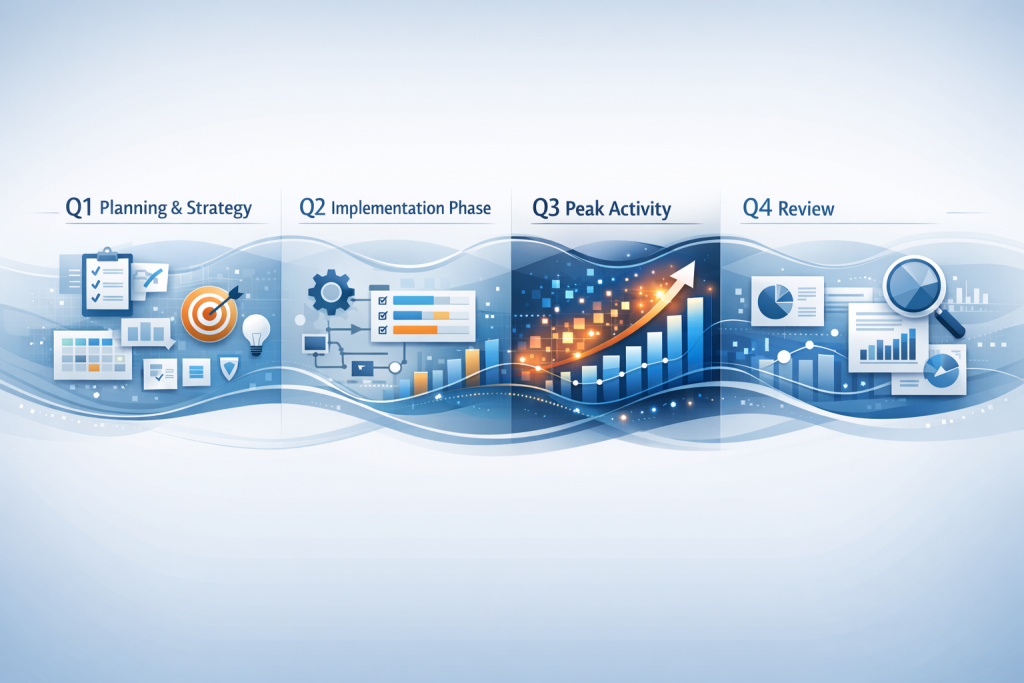
This starts with honest assessment of your seasonal pattern. Map out your typical year and identify peak demand periods, moderate activity periods, and relative quiet periods. For most businesses, this pattern is remarkably consistent year over year, driven by customer behavior, regulatory cycles, or market dynamics.
Once you understand your pattern, establish clear guidelines about what types of IT initiatives can happen during different periods.
During peak operational periods, limit IT changes to genuinely critical fixes and absolutely necessary security updates. This isn’t the time for system upgrades, new tool rollouts, major workflow changes, or infrastructure transformations. Your team needs to execute familiar workflows without distraction. Even beneficial changes create disruption that peak periods can’t absorb.
The only exceptions should be initiatives that directly support peak operations—for instance, scaling infrastructure to handle increased load or implementing tools specifically designed to reduce peak period workload. But even these should be implemented and stabilized before peak periods begin, not during them.
During moderate activity periods, implement lower-risk improvements that don’t require extensive training or workflow changes. System upgrades that maintain familiarity, incremental feature additions, infrastructure improvements that operate invisibly—these can typically absorb into normal workflow without overwhelming capacity.
During quiet periods, tackle major transformational initiatives that require significant learning, adaptation, and attention. New system implementations, major workflow redesigns, infrastructure migrations, comprehensive training programs—these benefit from the additional capacity and attention that quiet periods provide.
This timing discipline requires advance planning. You can’t wait until you’re in a quiet period to start planning what to do with it. IT initiatives require preparation—vendor selection, solution design, implementation planning—that should happen during busier periods so execution can happen during quiet ones.
This means establishing a rolling planning cycle that anticipates seasonal patterns. If your quiet period is May through August, you should be planning summer initiatives during the winter months. If your quiet period is January through March, you should be planning winter initiatives during the fall.
Infrastructure That Flexes With Demand
Beyond timing discrete IT projects around seasonal patterns, successful businesses build infrastructure that automatically accommodates seasonal demand variation without requiring manual intervention or causing disruption.
Cloud infrastructure provides the most obvious example. Rather than maintaining server capacity sufficient for peak demand year-round—paying for unused capacity during off-peak periods—cloud infrastructure can scale dynamically. During retail holiday seasons, e-commerce infrastructure automatically provisions additional capacity to handle traffic surges. During quiet periods, it scales back down, reducing costs.
This elastic infrastructure model extends beyond just server capacity to include storage, bandwidth, security services, and various software-as-a-service tools that charge based on utilization. When properly architected, your infrastructure costs track closely with revenue patterns rather than remaining fixed regardless of activity level.
Staffing models can follow similar patterns. Rather than maintaining full internal IT capacity year-round, organizations can supplement internal teams with managed services that provide surge capacity during peak planning and implementation periods. At Responsive Technology Partners, we see this pattern frequently with clients who have small internal IT teams that get overwhelmed during peak seasons or major initiatives. Our co-managed model provides expert support exactly when needed without requiring year-round staffing overhead.
Process automation creates another form of flexibility. Tasks that are manageable manually during slow periods can become overwhelming during peaks. Automated workflows for routine tasks—user onboarding, ticket routing, system monitoring, reporting—prevent operational bottlenecks when activity surges.
Security and compliance also benefit from elastic models. During peak periods when internal teams have no capacity for security monitoring, automated threat detection and managed security services ensure protection doesn’t degrade when attention is focused elsewhere.
The goal is infrastructure that automatically adapts to business rhythms rather than requiring manual scaling or creating constraints during peak periods.
Industry-Specific Patterns and Opportunities
Different industries have distinct seasonal patterns that create specific opportunities for strategic IT timing.
Accounting firms have perhaps the most pronounced seasonal pattern. January through mid-April demands absolute operational focus on tax preparation and filing. But May through December provides capacity for improvement initiatives. Smart accounting firms use this post-tax-season quiet period for implementing new practice management systems, upgrading document management, enhancing client portals, training staff on new tools, and improving processes that will serve the next tax season.
We’ve worked with accounting clients who schedule major technology initiatives specifically for May and June implementation, knowing staff has capacity after tax season exhaustion fades and before summer vacation season begins. They use July and August for training and refinement, then have systems stabilized and familiar before the next tax season preparation begins in late fall.
Retail businesses face the opposite calendar—quiet periods in early spring and late summer/early fall, with peaks during holiday season and back-to-school. This makes March through May and September through early October ideal windows for major IT initiatives. Implementing new point-of-sale systems, upgrading e-commerce platforms, or rolling out inventory management tools during these windows provides time for staff training and problem resolution before peak selling seasons.
Healthcare organizations should align IT initiatives with their enrollment calendar. Major system implementations during October through January create enormous risk given Medicare enrollment demands. But February through September provides capacity for implementing EHR systems, upgrading practice management tools, enhancing patient portals, and training staff on new workflows.
Hospitality businesses must consider their specific seasonal pattern—summer peaks for leisure destinations, winter peaks for ski areas, variable patterns for business hotels. But most have identifiable shoulder seasons where occupancy drops and staff has capacity. Using these periods for implementing property management systems, upgrading reservation platforms, or training on new service delivery tools minimizes guest impact while maximizing implementation quality.
Professional services firms can often use January and February—after year-end client push but before major projects fully launch—for internal IT improvements. Similarly, summer months when client activity traditionally slows provide windows for implementing project management tools, enhancing collaboration platforms, or upgrading infrastructure.
The pattern varies by industry and specific organization, but the principle remains consistent: identify your quiet periods and use them strategically for IT investment that would disrupt operations if attempted during peaks.
Multi-Year Planning Around Cycles
Strategic IT investment requires thinking beyond single-year cycles to consider how multi-year technology strategies align with seasonal business patterns.
Large-scale transformations—complete infrastructure modernization, comprehensive system replacements, fundamental workflow redesigns—can’t realistically complete within a single quiet period. They require multi-phase approaches that span multiple years.
The key is structuring these initiatives so major disruptions align with quiet periods while incremental progress continues year-round. For instance, a comprehensive cloud migration might follow this pattern: research and planning during moderate periods, major infrastructure moves during quiet periods, incremental application migrations across multiple quiet periods, with only minimal changes during peak seasons.
This requires discipline to resist the temptation to accelerate timelines by pushing implementation into peak periods just to meet arbitrary deadlines. Patience to allow transformations to unfold across multiple quiet periods almost always produces better outcomes than compressed timelines that force change during operational peaks.
It also requires communication and expectation management. Stakeholders expecting rapid transformation must understand why seasonal patterns necessitate measured pacing. The business case for transformation should explicitly account for implementation timing and the multi-year path to completion.
The “Implementation Window” Framework
To make seasonal timing practical rather than theoretical, organizations need clear frameworks for categorizing and scheduling IT initiatives.
We recommend a three-tier categorization system:
Tier 1 initiatives are transformational changes requiring significant attention and adaptation. New system implementations, major workflow redesigns, comprehensive training programs, infrastructure migrations—anything that fundamentally changes how people work belongs in Tier 1. These can only happen during quiet periods and require extensive planning to ensure readiness when windows open.
Tier 2 initiatives are significant improvements that don’t require fundamental workflow changes. System upgrades that maintain familiarity, feature additions that enhance existing tools, infrastructure improvements operating invisibly—changes that provide value without demanding extensive relearning. These can happen during moderate activity periods with appropriate planning and communication.
Tier 3 initiatives are routine maintenance and critical fixes. Security patches, minor bug fixes, necessary updates—changes required for ongoing operation regardless of timing. These happen as needed but should still be batched and communicated to minimize disruption.
With this framework, you can build an annual IT roadmap that maps initiatives to appropriate windows. Tier 1 projects get scheduled for quiet periods, ideally with backup dates if initial windows can’t accommodate everything planned. Tier 2 projects fill moderate periods. Tier 3 activities happen continuously but with regular maintenance windows.
This creates predictability for both IT teams and business users. Everyone knows major changes happen during specific windows, allowing them to plan around disruption. IT teams can prepare thoroughly since implementation windows are known well in advance. Business users can anticipate when they’ll need to invest attention in learning and adapting.
When Seasons Shift Unexpectedly
The strategic timing approach assumes seasonal patterns remain consistent, but sometimes patterns shift unexpectedly due to market changes, new regulations, or business developments.
When this happens, IT roadmaps must adapt while maintaining the principle of avoiding major changes during high-intensity periods. If a quiet period suddenly becomes busy due to unexpected opportunities, planned initiatives should postpone rather than proceeding during the newly busy window.
This requires maintaining flexibility in IT planning—having backup implementation windows identified, keeping vendor relationships structured to allow postponement without penalty, and building enough slack into timelines that delays don’t cascade through your entire roadmap.
It also requires clear decision criteria for truly urgent initiatives that can’t wait for ideal timing. These should be rare and reserved for situations where delay creates unacceptable business risk. The bar for overriding seasonal timing discipline should be high—most things that feel urgent aren’t actually urgent enough to justify operational disruption during peak periods.
Building This Into Your Planning Process
Making seasonal timing a consistent practice rather than an occasional consideration requires embedding it in your planning and decision-making processes.
During annual IT planning, your first step should be mapping the year’s seasonal pattern and identifying implementation windows. Before evaluating any proposed initiative, first determine its tier and when appropriate windows occur. This prevents the common pattern of approving initiatives without considering implementation timing, then scrambling to fit them into the calendar later.
For each significant IT initiative, timing should be an explicit part of the business case. What windows are appropriate? How long is implementation expected to take? What happens if implementation extends beyond the planned window? Having these discussions during planning prevents surprises during execution.
Governance processes should include timing review checkpoints. Before any Tier 1 or Tier 2 initiative proceeds to implementation, confirm that you’re entering an appropriate window and that operational demands haven’t shifted in ways that would make the timing problematic.
Communication about IT initiatives should explicitly reference seasonal timing. When announcing planned changes, explain not just what’s changing and why, but also why the timing was chosen to minimize operational impact. This builds understanding and buy-in for the discipline around seasonal timing.
The Strategic Advantage
Organizations that master seasonal IT timing create sustainable competitive advantages.
They avoid the operational disruption that comes from poorly timed initiatives, maintaining service quality and employee morale through peak periods. They achieve higher implementation success rates because changes happen when people have capacity to learn and adapt. They get better return on IT investment because implementations succeed rather than fail or require expensive remediation.
Perhaps most importantly, they build confidence in their ability to evolve and improve without sacrificing operational excellence. Employees trust that changes will be introduced thoughtfully rather than chaotically. Customers experience consistent service even as the organization transforms behind the scenes.
This creates organizational capability to innovate continuously rather than in disruptive bursts that create chaos and resistance.
Looking Forward
After thirty-five years in this industry, I’ve learned that success in technology isn’t primarily about choosing the right tools—it’s about implementing them at the right time in the right way. The most sophisticated technology poorly timed will deliver less value than simpler technology implemented when your organization has capacity to adopt it successfully.
As technology change accelerates and business environments grow more complex, the temptation increases to pursue continuous transformation regardless of timing. Resist that temptation. Your business has rhythms that create capacity variation throughout the year. Respect those rhythms rather than fighting them.
The right technology implemented at the wrong time is the wrong technology. Wait for the right window, plan thoroughly, and execute when your organization has capacity to succeed. Your operations, your employees, and your bottom line will all benefit from the discipline.
About the Author: Tom Glover is Chief Revenue Officer at Responsive Technology Partners, specializing in cybersecurity and risk management. With over 35 years of experience helping organizations navigate the complex intersection of technology and risk, Tom provides practical insights for business leaders facing today’s security challenges.
Eliminate All IT Worries Today!
Do you feel unsafe with your current security system? Are you spending way too much money on business technology? Set up a free 10-minute call today to discuss solutions for your business.