
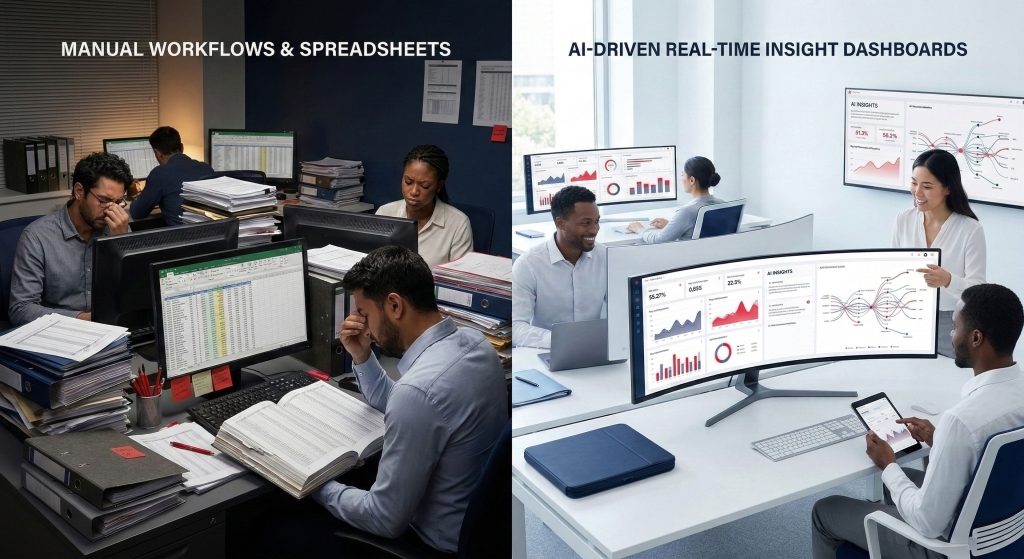
The way work gets done is changing fast. AI isn’t just another tool piling up tasks in someone’s inbox — it’s transforming manual, reactive work into automated, insight driven operations that enable faster decisions, higher productivity, and scalable growth. Organizations that embrace AI workflows and intelligent automation are moving beyond repetitive tasks and unlocking the strategic advantage of data driven operations.
What It Means to Shift from Traditional Tasks to AI Driven Work
Traditional task execution is often manual, time consuming, and reactive. Whether it’s combing through spreadsheets, filling out form after form, or performing routine checks, these tasks take time and attention away from high value work. AI changes that by:
- Automating repetitive and predictable work
- Surfacing insights from data without manual analysis
- Empowering teams to act with confidence and speed
- Freeing humans to focus on strategy, creativity, and decision-making
This evolution isn’t about replacing people — it’s about enhancing how humans and systems work together to create better outcomes. When AI handles the “how,” teams can focus on the “why.”
How AI Driven Work Boosts Productivity
AI driven work changes the distance between insight and action:
- Automated data processing: Instead of manually reviewing scores of dashboards or logs, AI can flag anomalies and patterns that matter.
- Smarter alerts: Systems can alert teams only when an issue truly requires human attention, reducing noise and increasing focus.
- Faster decisions: By summarizing complex datasets or generating actionable recommendations, AI accelerates decision cycles across departments.
This isn’t just faster — it’s fundamentally smarter. With AI supporting routine and analytical tasks, teams can scale without proportionally increasing headcounts.
Why Businesses Can’t Afford to Get Left Behind
Businesses that cling to purely manual processes risk lagging behind competitors that harness AI for operational advantage. The shift toward AI driven work means:
- Reduced operational friction — fewer bottlenecks in workflows
- Improved accuracy — humans focus on judgment and nuance
- Greater agility — teams respond quickly to change with real time insights
In competitive markets where speed and precision matter, automation and intelligent workflows are key differentiators.
Actionable Steps for Transitioning to AI Driven Operations
- Identify repetitive tasks first. Look for processes that are time consuming — these are ripe for automation.
- Embed AI into workflows. Select tools that integrate into everyday work rather than disrupt it.
- Train teams on new capabilities. AI is most effective when users understand how and when to leverage it.
- Measure impact. Track productivity, time saved, and decision quality to ensure your AI strategy delivers results.
Conclusion
The shift from traditional tasks to AI driven work isn’t optional — it’s the next frontier of operational excellence. By freeing teams from repetitive work and equipping them with intelligent, automated workflows, businesses can move faster, act smarter, and scale with confidence.
The Shift From Traditional Tasks to AI-Driven Work
The shift to AI-driven work is about more than automating tasks—it’s about helping teams work smarter. By reducing repetitive workloads, accelerating decision-making, and uncovering valuable insights, AI empowers organizations to improve productivity and focus on higher-value initiatives. Businesses that embrace intelligent workflows today will be better positioned to scale and compete tomorrow.