Learning Speed as Competitive Advantage: Adapting Faster Than Markets Change
Posted by K. Brown July 27th, 2026
Learning Speed as Competitive Advantage: Adapting Faster Than Markets Change
I had breakfast last week with a CEO whose company had just lost a major account to a competitor they’d never heard of six months ago. The competitor wasn’t better funded. They didn’t have superior technology. They weren’t even offering a significantly different service.
“What they had,” he told me, frustrated, “was the ability to adapt faster than we could. By the time we’d formed a committee to study their approach and develop our response, they’d already iterated three times and owned the relationship.”
This pattern keeps showing up. The companies winning in their markets aren’t necessarily the smartest or best-resourced. They’re the ones that learn and adapt faster than their competition can keep up with.
In a business environment where markets shift overnight, customer expectations evolve constantly, and competitive threats emerge from unexpected directions, learning speed has become the differentiating capability. Not what you know today, but how quickly you can learn what you need to know tomorrow.
The Velocity Question
Most business leaders think about competitive advantage in static terms. We ask: What do we do better than competitors? What unique capabilities do we have? What’s our defensible position?
These questions made sense in slower-moving markets where competitive positions could be established and held for years. Build a better product, establish brand recognition, achieve economies of scale, and those advantages would sustain you through market cycles.
That model is breaking down. The half-life of competitive advantage keeps shrinking. What works today might be obsolete in months. The unique capability you spent years developing can be replicated or bypassed faster than ever.
The more relevant question is becoming: How fast can we learn? Not what we know, but how quickly we can recognize when what we know is no longer sufficient and develop new understanding.
I’ve watched organizations with inferior starting positions overtake better-resourced competitors simply by learning faster. They recognize market shifts earlier. They experiment more rapidly. They incorporate feedback more effectively. By the time slower competitors have analyzed the situation and planned their response, fast learners have already adapted.
This creates a compounding advantage. Organizations that learn faster don’t just respond to current changes more effectively—they’re better positioned to handle the next change because they’ve developed the capability for rapid learning itself.
The Cost of Slow Learning
The penalty for slow learning isn’t just missing opportunities. It’s making decisions based on increasingly obsolete understanding while convinced you’re being thoughtful and deliberate.
I see this pattern constantly. An organization faces a market shift. They form a committee to study it. They commission research. They develop recommendations. They debate options. They build consensus. They plan implementation. By the time they’re ready to act, the market has moved again. Their carefully considered response addresses yesterday’s reality.
Meanwhile, faster-learning competitors have run three cycles of experimentation. They tried something, saw what happened, adjusted, and tried again. They’re operating with current market feedback, not six-month-old analysis.
The gap compounds. While slow learners are implementing their first response, fast learners have already incorporated feedback from multiple iterations. They’re not just further ahead—they’re learning from more data points, which accelerates their next cycle of learning.
This creates what I call the learning gap—the distance between what an organization thinks they understand about their market and what’s actually true. For slow learners, that gap widens continuously. For fast learners, it narrows.
What Creates Learning Speed
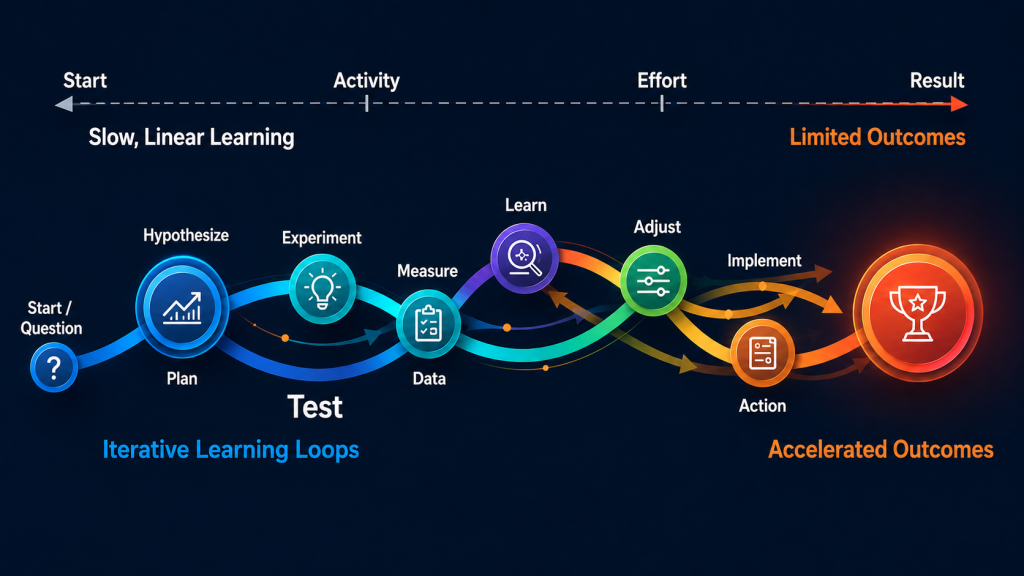
Learning speed isn’t about rushing decisions or acting recklessly. It’s about compressing the cycle from recognizing a need to learn through gaining new understanding to incorporating that understanding into action.
Organizations that learn quickly share several characteristics.
First, they have direct feedback loops. They’re close enough to customers, markets, and operations to see what’s actually happening without the signal degrading through layers of reporting. When something changes, they know quickly because they’re paying attention to the right indicators.
At RTP, we monitor threat intelligence continuously because the cybersecurity landscape evolves faster than almost any other domain. A new attack vector can emerge and spread globally in days. If we waited for quarterly threat assessments to understand what’s happening, we’d be dangerously behind. Our security team consumes threat intelligence daily, discusses implications weekly, and adjusts approaches in real time.
That direct connection to changing reality creates the foundation for learning speed. You can’t learn quickly from information that takes weeks to reach you or gets filtered through multiple interpretations before you see it.
Second, fast learners separate experimentation from execution. They have mechanisms for trying things at small scale, learning from results, and incorporating lessons before committing at full scale. This dramatically reduces the cost and risk of learning.
Traditional organizations treat every decision as final. Once committed, they’re invested in making it work regardless of feedback. Fast learners treat decisions as experiments until proven. They maintain the ability to course-correct based on what they learn.
Third, they’ve built cultures where learning from failure is valued more than avoiding failure. When mistakes happen—and they will when you’re experimenting—the response isn’t punishment but analysis. What can we learn from this? How do we adjust?
This might be the hardest cultural shift for most organizations. We’re trained to value being right, to punish mistakes, to reward those who avoid failures. That creates environments where people hide problems, avoid risks, and resist admitting when approaches aren’t working.
Fast-learning organizations flip this. They celebrate the person who says “this isn’t working” early enough to change course. They reward teams that run experiments, even failed ones, because the learning has value. They treat mistakes as data rather than sins.
The Black Box Principle
The aviation industry offers the best model I’ve seen for organizational learning. When a plane crashes, they don’t look for someone to blame. They find the black box, analyze every detail of what happened, determine root causes, and change protocols across the entire industry.
Because of this approach, aviation gets safer every time something goes wrong. The system learns from failures. Crashes become increasingly rare not because pilots are more skilled or planes are inherently safer, but because the industry has developed exceptional capability for learning from mistakes.
Most businesses operate differently. When something goes wrong, the first question is “who’s responsible?” The focus is on accountability and ensuring someone faces consequences. This creates powerful incentives to hide problems, shift blame, and avoid transparency about what actually happened.
You can’t learn quickly in an environment where admitting mistakes is career-limiting. People won’t surface issues early when they’re still easy to fix. They won’t experiment because failure has personal costs. They’ll wait until problems become undeniable crises before raising them.
Building a black box culture means changing the questions you ask when things go wrong. Instead of “who did this?” ask “what can we learn?” Instead of “how do we prevent this person from making this mistake again?” ask “how do we prevent anyone from making this mistake again?”
This requires leadership discipline. Your natural instinct when something goes wrong is to hold someone accountable. Resisting that instinct in favor of focusing on learning creates space for the honest analysis that makes future learning possible.
The Experiment Mindset
Fast learners don’t treat every decision as permanent. They distinguish between reversible and irreversible choices and handle them very differently.
Irreversible decisions—major vendor commitments, fundamental architecture choices, regulatory positions—deserve careful deliberation. Get input from stakeholders. Analyze options thoroughly. Move deliberately because course correction will be expensive or impossible.
Reversible decisions can move quickly with less ceremony. Try something at small scale. See what happens. If it works, expand. If it doesn’t, adjust. The cost of being wrong is low because you can change direction.
Most organizations apply the same rigorous process to both types of decisions. Everything requires the same levels of analysis, approval, and deliberation. This creates institutional slowness where it’s least needed.
I’ve watched companies spend months debating decisions that could have been tested in weeks. Should we change our onboarding process? Instead of endless meetings analyzing pros and cons, try the new approach with the next five clients and see what happens. The learning from actual experience will be more valuable than any amount of theoretical analysis.
This experiment mindset requires comfort with uncertainty. You’re launching things without complete confidence they’ll work. You’re accepting that some experiments will fail. That discomfort is precisely why many organizations avoid this approach.
But the alternative—waiting until you’re certain before acting—guarantees you’ll be slow. Certainty requires extensive analysis and debate. By the time you’re certain, faster competitors have already learned from actual experience.
Learning Loops in Practice
At RTP, our ability to serve clients effectively depends entirely on learning speed. The threat landscape we operate in changes continuously. New vulnerabilities emerge. Attack techniques evolve. Regulatory requirements expand. If we learned at the pace of traditional annual strategic planning cycles, we’d be dangerously obsolete.
Instead, we’ve built learning into our operational rhythm at multiple timescales.
Daily threat intelligence monitoring keeps us current on emerging threats. Our security team reviews new attack vectors, vulnerability disclosures, and threat actor activity every day. When something significant emerges, we’re analyzing implications immediately, not waiting for a quarterly review.
Weekly technical team meetings focus explicitly on what we’re learning. Not just project updates or status reports, but “what did we learn this week that changes how we should approach security?” These sessions create space for sharing insights from client work, discussing new techniques we’ve encountered, and incorporating lessons into our approaches.
Monthly service reviews with clients include discussions of how the threat landscape is evolving and what adjustments make sense. We’re not just reporting on what we did—we’re incorporating recent learning into recommendations for how they should adapt.
Quarterly strategic reviews look at broader patterns. What are we seeing across our client base? What capabilities do we need to develop? Where should we invest in training or tools? These sessions incorporate learning from hundreds of daily and weekly cycles into longer-term strategic adjustments.
This creates a learning metabolism that operates at multiple speeds. Tactical learning happens daily. Strategic learning happens quarterly. But both are happening continuously rather than as occasional events.
The Failure Advantage
Here’s a counterintuitive truth: organizations that fail more often often succeed more consistently than those that avoid failures. Not because failure itself is good, but because frequent small failures create learning opportunities that prevent catastrophic large failures.
When you only launch things you’re certain will succeed, you’re launching rarely. You’re also launching based on analysis rather than evidence. When you do fail—and eventually you will—it’s typically a significant failure because you’ve committed heavily before learning the approach doesn’t work.
Organizations comfortable with small failures experiment constantly. They try things at limited scale, learn quickly whether they work, and course-correct before investing heavily. Most experiments yield useful learning even when they don’t produce the hoped-for results. The few that work exceptionally well get scaled up.
The cumulative effect is that frequent experimenters learn faster and fail less catastrophically than those who try to avoid failure. Their small, controlled failures prevent the big, uncontrolled ones.
This requires reframing how you think about failure. In most organizations, failure is bad. The goal is to have zero failures. This creates an environment where people avoid risks and hide problems.
In learning-focused organizations, the right number of failures is greater than zero. If you’re not failing sometimes, you’re not experimenting enough. You’re playing it too safe, which means you’re learning too slowly.
The key is controlling failure scale. Small experiments with limited downside create learning without catastrophic risk. You want many small failures that teach you things, not one large failure that breaks the business.
The Speed-Quality Balance
A common objection to learning speed is that it compromises quality. If you’re moving fast and experimenting, aren’t you delivering inferior work?
This misunderstands the relationship between speed and quality over time. In any given moment, yes—a carefully considered approach might produce marginally better results than a rapid experiment. But over multiple cycles, fast learners produce better outcomes because they’re incorporating more feedback.
The carefully considered approach launches once based on extensive planning. The rapid experimentation approach launches, learns, adjusts, launches again, learns more, adjusts again. By the third or fourth iteration, the experimental approach is incorporating real market feedback that wasn’t available during the planning phase.
The question isn’t whether you can produce a perfect solution slowly versus an imperfect solution quickly. It’s whether you can produce a good solution that gets better quickly versus a planned solution that may or may not match reality.
In cybersecurity, we see this constantly. Threat actors don’t wait for perfect attacks—they probe constantly, learn from what works, and adapt. Defensive approaches that take months to develop and deploy are often obsolete before implementation because the threat landscape has moved.
Defensive strategies that launch quickly, monitor effectiveness, and adjust based on actual attack patterns remain relevant because they’re adapting as fast as threats evolve. The initial deployment might be less comprehensive than a fully-planned approach, but it’s learning from real data and improving continuously.
Building Your Learning Infrastructure
If learning speed is becoming the critical competitive advantage, how do you build it systematically rather than hoping it emerges organically?
Start by creating explicit feedback mechanisms. How will you know when your understanding of the market is becoming obsolete? What signals will tell you customer needs are shifting? Who’s responsible for monitoring competitive moves and emerging threats?
Many organizations assume they’ll somehow know when change is happening. They rely on leadership’s general awareness or hope that someone will notice and raise issues. This is far too passive for environments that change quickly.
Build active listening into your operations. Assign people to monitor specific domains—customer feedback, competitive intelligence, regulatory developments, technology trends. Make monitoring a job responsibility, not something people do if they have time.
Create forums for sharing learning. In most organizations, learning that happens in one part of the business stays there. The sales team learns something about customer needs but doesn’t share it with product development. Operations discovers a more efficient process but doesn’t tell other locations.
Systematic knowledge sharing accelerates organizational learning by multiplying the value of individual insights. What one person or team learns becomes available to everyone. We do this through regular cross-functional meetings where different teams share recent learning. Not formal presentations—just “here’s something interesting we encountered this week.”
Document experiments and results. When you try something new, capture what you did, what happened, and what you learned. This creates an organizational memory that prevents repeating failed experiments and enables building on successful ones.
Most importantly, reward learning behaviors. Celebrate people who experiment. Recognize teams that adjust quickly based on feedback. Promote leaders who build learning capabilities in their areas. What you reward is what you get more of.
The Conversation That Changed My Thinking
Years ago, I was frustrated that a competitor seemed to always be ahead of us. They weren’t smarter. They didn’t have better resources. But they consistently got to market with new capabilities before we did.
A mentor pointed out something I’d missed. “They’re not necessarily faster at execution,” he said. “They’re faster at learning. By the time you’ve thoroughly analyzed whether something is worth doing, they’ve already tried it and know whether it works.”
He was right. We were optimizing for being right the first time. They were optimizing for learning quickly. Our first implementations were more polished. Their first attempts were rougher. But their fourth or fifth iteration was informed by real experience while we were still on our first deployment.
That insight changed how I thought about competitive advantage. Being smart matters. Having resources matters. But the ability to compress learning cycles—to get from question to answer to action and back to refined question—creates advantages that compound over time.
Where This Leads
The acceleration isn’t slowing down. Markets will continue changing faster. Technologies will continue evolving rapidly. Customer expectations will continue shifting. The organizations that thrive won’t be those with the best current position. They’ll be those that can adapt their positions faster than competitors.
This has implications for how you hire, how you structure teams, how you make decisions, how you measure success, and how you think about leadership.
Hire for learning ability over current knowledge. Someone who can learn quickly will remain valuable as requirements change. Someone with deep knowledge of current systems becomes less valuable as those systems become obsolete.
Structure teams to enable rapid iteration. Long approval chains and heavy process might prevent mistakes, but they also prevent the quick cycles that create learning. Fast-learning organizations push decision authority down and accept that some decisions will need to be reversed.
Measure learning velocity alongside traditional metrics. How quickly do you recognize shifts? How many experiments are you running? How fast do you incorporate feedback? These process metrics predict future performance better than lagging indicators of past success.
Most fundamentally, this changes what leadership means. The leader’s job isn’t to have all the answers or make all the decisions. It’s to create an environment where the organization can learn and adapt faster than the competition.
That’s the competitive advantage that matters most. Not what you know today, but how quickly you can learn what you’ll need to know tomorrow.
Tom Glover is Chief Revenue Officer at Responsive Technology Partners, specializing in cybersecurity and risk management. With over 35 years of experience helping organizations navigate the complex intersection of technology and risk, Tom provides practical insights for business leaders facing today’s security challenges.
Eliminate All IT Worries Today!
Do you feel unsafe with your current security system? Are you spending way too much money on business technology? Set up a free 10-minute call today to discuss solutions for your business.