
Trust in the Algorithm Age: What AI Can’t Replicate
Trust, in the sense that actually matters in business relationships, is not the same thing as reliability. Reliability is a measurable property of a system: it performs consistently, produces accurate outputs at a known rate, and fails in predictable ways. A very good AI system can be extraordinarily reliable. But reliability and trust are different categories, and the conflation of the two is one of the more consequential misunderstandings shaping how organizations are deploying these tools right now. The gap between them becomes most visible exactly when it matters most — under pressure, after something has gone wrong, in the moment when someone needs to make a call that the data alone cannot make for them.
This is not an argument against AI. The tools are genuinely impressive and getting more so, and any serious assessment of what modern organizations need to remain competitive and secure has to include them. But the organizations getting the most from AI adoption right now are the ones that are clear-eyed about what they are actually handing to the algorithm and what they are not. That clarity is harder to maintain than it sounds, because the pressure to automate everything — to reduce costs, to eliminate human error, to scale without adding headcount — pushes relentlessly against it. The question is not whether to use AI. It is whether the people running your organization understand which problems AI is built to solve, and which ones it will confidently appear to solve while quietly making worse.
What the Algorithm Does Extraordinarily Well
Any honest conversation about AI’s limits has to start with a genuine accounting of its capabilities, because dismissing the tools as overhyped does not help anyone navigate them well.
Pattern recognition at scale is the core of what modern AI does, and it does it at a level that has no human equivalent. In cybersecurity specifically, this matters enormously. The volume of signals, events, and potential anomalies that a reasonably complex network generates every single day is beyond any practical human capacity to monitor with the kind of consistency that real protection requires. Threat actors who target mid-sized organizations are patient. They probe over days and weeks. They establish a foothold and wait. They look like normal network traffic right up until they do not. Detecting the subtle deviation from baseline behavior that indicates something is actually wrong — across thousands of endpoints, across millions of daily events, in close to real time — is work that AI-assisted tooling handles far better than human analysts working without it.
The same logic applies to fraud detection in financial services, to anomaly identification in healthcare billing, to email filtering, to vulnerability scanning. These are pattern-matching problems at high volume, and high-volume pattern matching is where AI earns its place in the stack. Any serious security operation that is not using these tools is operating at a structural disadvantage, and any managed security partner worth the relationship is running AI-assisted detection as foundational infrastructure, not as a premium add-on. The argument is not that AI does not work. In these contexts, it works remarkably well. The argument is about what happens after the pattern is detected — and whether the tools used to surface the signal are the same tools equipped to decide what it means and what to do about it.
The Judgment Problem
Anomaly detection is a solved problem in a way that judgment is not. An AI system can tell you that a pattern of behavior falls outside established norms. It cannot tell you whether that departure represents an attacker who has compromised a user account, an employee traveling internationally who forgot to notify IT, a new application being tested by the development team, or a vendor making an authorized change at an unusual hour. These scenarios can produce identical-looking signals. The correct response to each is entirely different.
This is where judgment enters, and judgment is not a computational problem in the way pattern recognition is. Judgment requires contextual understanding accumulated over time through relationships, history, and experience — not through training data. The analyst who has worked with a particular organization for three years knows their development team’s habits. They know the CFO travels to Europe every quarter. They know a specific vendor has a maintenance window the third Saturday of the month. They know the company just concluded an acquisition, that the new subsidiary is coming onto the network in phases, and that unusual access from certain IP ranges this week is expected and documented. That knowledge does not live in a dataset. It lives in a person’s working memory and their ongoing relationship with the environment they are responsible for protecting.
The organizations that are getting AI deployment wrong are not failing because the tools are insufficient. They are failing because they have handed decision-making authority to the algorithm while assuming the tool’s output carries the same weight as experienced human judgment. The tool surfaces the signal. An experienced human, with real context, interprets what it means. Remove the second step and you do not get more efficient security — you get an organization that is rapidly responding to the wrong things while missing what actually matters.
The Confidence Problem
There is a second-order effect of AI adoption that gets almost no attention relative to the first-order question of whether the tools work: what happens to organizational judgment over time when decisions are increasingly routed through systems that express high confidence regardless of whether that confidence is warranted.
Modern AI systems do not hedge well. They produce outputs that arrive with a presentation that reads as authority. For pattern-matching tasks where the system genuinely has high accuracy, this is appropriate and useful. But for tasks that require contextual interpretation — exactly the category where human judgment is irreplaceable — that same confident presentation can create the impression that a determination has been made when it has only been flagged. The risk is not that organizations will suddenly trust a bad output wholesale. It is subtler and slower than that.
Over months and years of treating algorithm outputs as near-determinations, the people responsible for evaluating those outputs gradually stop building the experiential base that would let them catch the cases where the algorithm is wrong. The feedback loop that develops expertise — make a judgment, see what happens, update your mental model, make a better judgment next time — atrophies when most judgments are being routed through the system instead. By the time a situation arises that genuinely requires experienced human judgment, the humans available to make that call may be meaningfully less prepared to make it than they would have been if they had been engaged throughout. Organizations that keep their expert teams genuinely engaged with interpretation and decision-making — routing real cases through real analysts rather than only escalating the exceptions the algorithm flags as high-priority — are building something durable. Organizations that use AI to thin the human layer to a minimum are building in a structural fragility that the tools will eventually reveal.
The Asymmetry of Failure
It is worth examining what failure actually looks like in each direction, because the two modes are not symmetric and the difference matters for how you design your security program.
When a human expert makes a bad judgment call — misreads a signal, escalates something that turned out to be benign, fails to catch an early indicator of an intrusion — the failure is visible, attributable, and correctable. The person involved can examine what they missed and why. Their colleagues can learn from the specific gap. The organization can adjust its processes based on an understood failure. Human judgment fails in ways that generate learning and feed back into improvement.
When AI-deferred judgment fails — when an organization has built its security posture around the algorithm’s determinations and the algorithm misses something important, or confidently classifies a real threat as a benign false positive — the failure is often invisible until it is catastrophic. There is no person who thought it through and got it wrong. There is only a system that processed a signal and produced an output, with no feedback loop that produces organizational growth. This asymmetry is one of the most underappreciated risks in security program design. Building a program that holds up under pressure means building one where human judgment is engaged continuously, not just on exception.
The Accountability Gap
There is a dimension of trust that has nothing to do with accuracy, and it is often the last to get discussed in AI adoption conversations: accountability.
When something goes wrong — when a breach is not caught in time, when a patient record is exposed, when a financial client’s data is compromised — the person who has to stand in front of the executive team and explain what happened, who has to call the affected client, is a person. Not a model. Not a platform. A person. The accountability that makes a trust relationship real — the kind that says I am responsible for this, and you can hold me to that — cannot be delegated to software.
In regulated industries, this is not philosophical; it is operational and increasingly personal. HIPAA’s accountability framework requires organizations to designate a responsible party for information security. The FTC Safeguard Rule requires a qualified individual to own the program. These frameworks exist because regulators understand what every experienced leader also understands: rules without a responsible human behind them are just text documents. And this accountability is becoming personal in ways it was not a decade ago. Boards are asking harder questions about who specifically owns the security program and what their qualifications are. Cyber liability carriers ask the same questions at renewal. When the accountability question comes — and it comes in every serious incident — the answer cannot be the algorithm flagged it. Someone’s name has to be on it, and that requires a person who accepted the responsibility before the incident occurred.
What Clients Are Actually Trusting
It is worth being precise about the object of trust in a managed services relationship, because the AI conversation can obscure it. Clients working with a managed security partner are not trusting the tooling. They are not extending faith to a detection platform or an MDR stack. The tools are infrastructure — necessary, well-chosen, running continuously — but they are not what the client relationship is built on.
What clients actually trust is judgment, accountability, and consistency of relationship over time. They trust that when something happens at two in the morning, there is a human being who understands their environment, knows their risk tolerance, and can make the right call about whether to wake the executive team or handle it through standard procedure. They trust that when a new compliance requirement lands, there is someone who will translate what it means for their specific situation because they know that organization well enough to understand what actually matters to them. They trust that the person who explained their security posture to their board last quarter will still be there next quarter and will remember what was said.
That continuity is not a soft benefit. It is the mechanism by which trust accumulates, and it is what separates a security relationship that actually functions from one that exists only on paper. A platform does not remember the conversation about risk appetite eight months ago. It does not know that the organization just went through an acquisition and that network boundaries changed in ways not yet fully documented. It does not understand that the CFO needs to be briefed differently than the CTO, or that the board’s appetite for security investment shifted after a competitor was hit last spring. The platform that processes your network traffic has no awareness of the strategic context behind an unusual spike in after-hours access — whether it reflects a product launch, a crisis response, or something that genuinely warrants a phone call at midnight. The person who has been in your quarterly reviews does. These are the things that make the difference when a real decision has to be made under real pressure, and they are what distinguish a security relationship that genuinely protects from one that merely processes.
Where the Human Layer Has to Live
The human layer in a security program is not optional, and it is not satisfied by having any warm body nominally responsible. The specialist — whether in-house or co-managed — needs to hold the actual relationship layer of the security program: the accountability, the judgment in ambiguous situations, the direct communication with leadership and board.
Internal IT generalists are not the right people to carry this weight, not because they are not capable — they frequently are — but because dedicated security focus is a full-time discipline requiring continuous immersion in threat intelligence, incident patterns, and regulatory development. The depth of expertise that allows a specialist to distinguish a real incident from noise, to read a regulatory update and immediately understand what it means for a specific client’s program, to recommend a control adjustment before a vulnerability becomes a breach — this depth is built through sustained, dedicated focus that the same person managing help desk tickets and server migrations simply cannot maintain simultaneously.
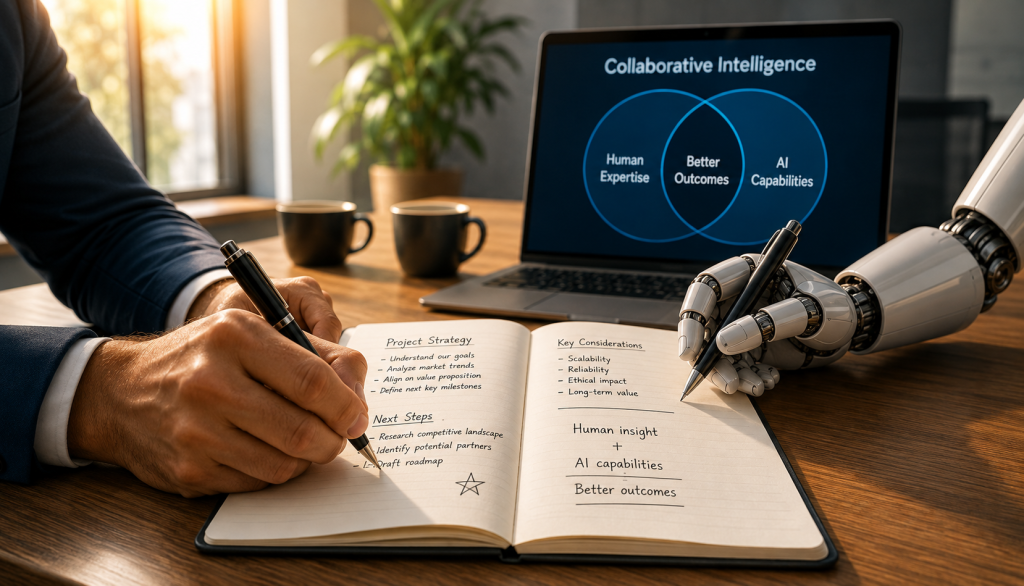
What works is the model where internal IT and the specialist partner each carry what they are actually built for. Internal IT handles what it does best: daily operations, user support, line-of-business technology, the relationship with the business itself. The specialist partner handles security: continuous monitoring, threat intelligence, incident response, compliance program ownership, and the direct accountability relationship with leadership. The AI tools serve both layers, compressing the volume of information either team would have to process manually. The human layers decide what that information means and who is responsible for what happens next. This is not a turf question or a budget question. It is a structural question about which kinds of expertise are actually able to carry which kinds of accountability — and answering it honestly is what separates security programs that hold up from ones that fail at the worst possible moment.
The algorithm is not a peer. It is an instrument. The most important thing about how you use it is remembering the difference — and building the human infrastructure that ensures no one ever mistakes the signal for the judgment.
Tom Glover is Chief Revenue Officer at Responsive Technology Partners, specializing in cybersecurity and risk management. With over 35 years of experience helping organizations navigate the complex intersection of technology and risk, Tom provides practical insights for business leaders facing today’s security challenges.
Eliminate All IT Worries Today!
Do you feel unsafe with your current security system? Are you spending way too much money on business technology? Set up a free 10-minute call today to discuss solutions for your business.