
Systems Thinking for Non-Technical Leaders
The most consequential technology decisions most organizations make are not made by the people with the deepest technical expertise. They are made by executives and board members who are responsible for setting strategic direction and approving significant investment, who carry extensive expertise in their own domains, and who are navigating a category of decision they have not necessarily spent careers developing fluency in. This dynamic is not a failure of leadership. It is simply the reality of how most organizations are structured, and it creates a specific and genuinely addressable skill gap that is worth naming directly rather than working around or papering over with better presentation decks from the technology team.
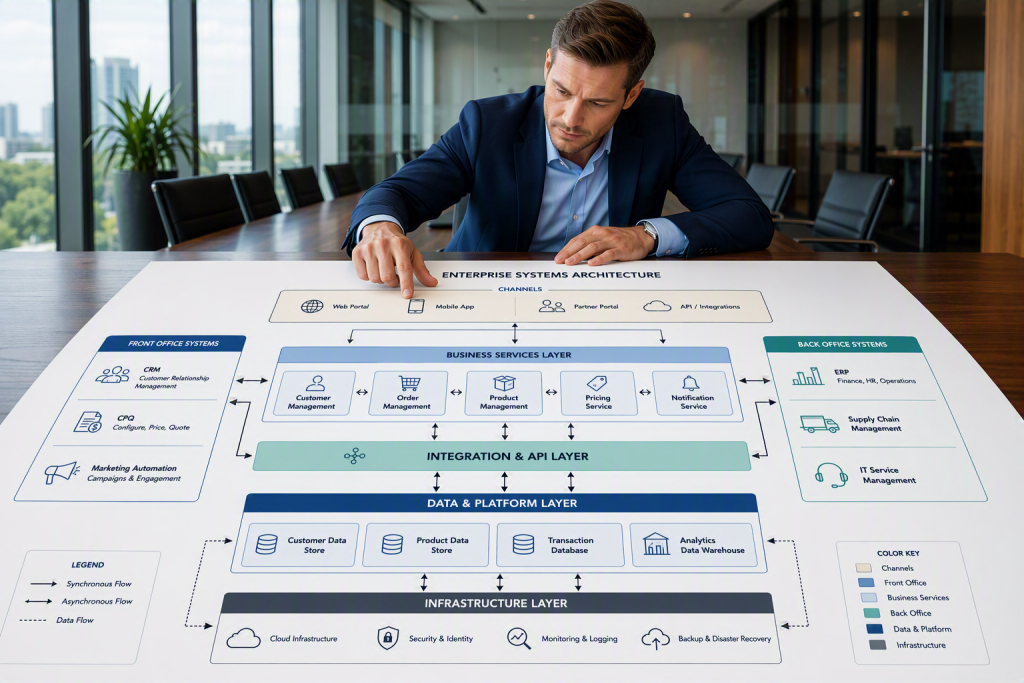
The skill is not technical knowledge. Leaders do not need to understand how a firewall works or what distinguishes endpoint detection from network detection, and the expectation that they should is one of the more persistent and counterproductive myths in the technology governance conversation. What they need — and what is genuinely learnable without a technical background — is the ability to think about technology as a system rather than as a collection of independent tools, and to apply that systems perspective to the strategic decisions that cross their desks. The term for this is systems thinking, and while it sounds like something that belongs in a graduate engineering program, the core principles are accessible and immediately applicable to business decision-making without requiring any technical depth at all.
Why Architecture Matters More Than Tools
The most common version of technical confusion at the leadership level is not a misunderstanding of any particular technology. It is a misunderstanding of how technologies relate to each other — how a decision about one affects options and vulnerabilities in another, how the accumulation of independent point solutions can create more exposure than a coherent architecture, and how the right question about any major technology investment is usually not “does this tool do what it claims” but “how does this change what the rest of the system can and cannot do.”
A practical example: an organization approves a new cloud storage platform because the business unit requesting it has a compelling need and the platform has strong references. The IT team implements it. Six months later, a security incident reveals that the new platform’s credential management was configured in a way that created an exposure in the identity system that touched eleven other applications. No individual decision was wrong. The result was a vulnerability that none of the individual decisions, evaluated independently, would have flagged.
This is a systems problem, and it is a representative one. The tools were evaluated in isolation. The connections between them — the places where a change in one ripples through its dependencies in ways that are not visible from the surface of any individual change — were not part of the evaluation. A non-technical leader who thinks in systems would have known to ask: what does this change, beyond the thing it is directly intended to change? That question requires no knowledge of how credential management works or what an identity system does. It is a systems question, and it is the question that would have caught the problem before it became an incident.
The Interdependency Principle
The foundational principle of systems thinking as it applies to technology decisions is interdependency: every component in a complex system is connected to other components, and a change to one component produces effects that travel through those connections in ways that are not always visible from the surface of the change itself.
This principle has several practical applications for how non-technical leaders approach technology decisions.
The first and most consequential is that isolated evaluation is almost always insufficient for significant technology investments. When a department requests a new tool or platform, the evaluation that matters is not whether the tool performs its stated function well. It is whether the tool, in the context of everything it connects to, produces the outcomes the organization actually needs. That evaluation requires the people who understand those connections — the IT and security team — to be part of the decision process, not consulted after the decision has already been made.
The second principle is that the true cost of a technology decision is not fully represented in its price tag. The cost includes the integration work required to connect it to existing systems, the training required to develop the organizational capability to use it well, the ongoing maintenance required to keep it current with the other components it touches, and the cost of retiring it when it is eventually replaced — a cost that compounds with every integration it has accumulated. Organizations that understand the full cost of technology additions tend to make fewer, better-integrated decisions rather than many independent ones.
The third, and the one most consistently underweighted, is that security cannot be an afterthought in technology architecture. Security controls are not a layer applied on top of an existing system. They are embedded in how the components of the system relate to each other — in the identity and access structures, in the data movement patterns, in the privilege configurations, in the monitoring coverage. A technology architecture that has not been designed with security integrated is not neutral. It is actively generating risk that will require either remediation investment or acceptance of exposure. Non-technical leaders who understand this are the ones who ask the security question early rather than waiting until the security team flags a problem after the fact.
What Non-Technical Leaders Actually Need to Ask
The good news about systems thinking is that it does not require technical expertise to practice. It requires a set of questions that, applied consistently, shift the nature of technology conversations in ways that produce better outcomes without requiring the leader to develop deep technical knowledge.
The most useful of these questions is: what does this change? Not what does this tool do, but what does adding it, changing it, or removing it change about the rest of the environment it lives in. This question surfaces the interdependency that isolated evaluation misses, and it is a question any leader can ask of any technical recommendation without needing to understand the technical details of the answer.
The second question is: what do we lose if this fails? Technology investments are often evaluated almost entirely on the upside — the capability they add, the efficiency they generate, the problem they solve. The downside case is underexamined. A non-technical leader who consistently asks what the failure mode looks like, and what the organization’s exposure would be if the failure happened, develops a more realistic picture of the actual risk profile of technology decisions. This is not pessimism. It is the systems thinker’s recognition that any component in a complex system will eventually fail, and that the design of the system should account for that.
The third question is: who is accountable for this working? Technology initiatives that lack a clearly named human owner — a specific person who is responsible for outcomes rather than just for delivery — tend to produce exactly the accountability gaps that create risk. The person who approved the system is not accountable for its ongoing security posture. The vendor who sold it is not accountable for how it integrates with everything else in the environment. The IT team that implemented it may be accountable for uptime but not for the business outcomes it was supposed to produce. Naming accountability explicitly, for both implementation and ongoing operation, is a systems question that any leader can apply to any technology decision.
The Leadership Advantage of Systems Fluency
Leaders who develop genuine systems fluency — who can think about technology decisions in terms of interdependency, full cost, and accountability — have a practical advantage that goes beyond their ability to evaluate individual technology proposals.
They are better positioned to have productive conversations with their technical teams, because they are asking questions that the technical team recognizes as the right questions rather than the questions of someone who needs to be managed. They are better positioned to develop useful oversight of the technology function, because their frame of reference is aligned with how the people responsible for the technology environment actually think about it. They are better positioned to catch the category of risk that tends to go unaddressed in organizations where the line between the technical and non-technical leadership is treated as impermeable — the strategic risk that emerges from technology decisions made without adequate consideration of their systemic implications.
This is also where the relationship between leadership and the security function becomes most valuable. A security partner who is engaged in the early stages of technology decisions — before architectures are locked in and integrations are built — can translate the technical implications of those decisions into the business and risk language that leadership works in. The systems question that a non-technical leader does not know to ask is exactly the question that a good security partner is positioned to surface. The leadership advantage of systems fluency is multiplied when it is paired with technical partners who are doing the same work from the other direction.
The Difference Between Oversight and Approval
One of the most important distinctions for non-technical leaders to develop is the difference between technology oversight and technology approval. Most organizations have the latter without the former, and the gap is where strategic risk accumulates.
Technology approval is what happens when a department requests a tool, IT evaluates it technically, finance approves the spend, and leadership signs off. This is a legitimate process. It produces appropriate controls over spending. What it does not produce is genuine understanding of the cumulative direction the technology environment is moving, the emerging risk concentrations that develop as independent decisions stack up over time, or the strategic coherence — or lack of it — between the individual decisions being made.
Technology oversight requires something more: the regular, structured review of the technology environment as a whole, not just the individual decisions flowing through the approval process. What is the current architecture, and how has it changed over the past year? Where are the concentrations of risk — the components on which too many other things depend, the systems that have not been updated to current standards, the integrations that were built years ago and have never been reviewed? What decisions are being deferred, and what is the cost of deferring them? These are the questions that governance requires but that a transaction-by-transaction approval process cannot answer.
The organizations where this kind of oversight exists tend to have a specific structural feature: there is a direct line between the security and technology leadership and the executive team or board, operating independently of the budget-approval process. Not a channel that opens when there is a crisis or a purchase request, but a regular cadence at which the people responsible for the technology environment’s actual posture are briefing the people responsible for the organization’s governance. The insights that come from that channel — the emerging risks, the deferred decisions, the architecture decisions that look reasonable individually but create systemic exposure collectively — are the insights that allow oversight to function rather than just approval.
The Practical Bridge
None of what is described in this piece requires non-technical leaders to become technical. It requires them to become comfortable with a different kind of conversation with their technical partners — one that is oriented around systems questions rather than tool questions, and that treats the technology environment as a strategic domain requiring the same quality of governance as the financial or operational domains.
The practical bridge is usually a trusted technical partner who can translate meaningfully between the two languages — who understands both the architecture well enough to describe its strategic implications and the business well enough to frame those implications in terms that match how the leader actually makes decisions. This is the role a good managed security partner plays in organizations where the relationship is working well: not just running the security program, but connecting the technical realities of the environment to the strategic decisions the leadership team is making and the risk posture the board is responsible for overseeing.
The leaders who develop systems fluency tend to describe the same shift in their experience of these conversations: they stop feeling like they are at a disadvantage in discussions about technology, because they have come to understand that the most important questions in those discussions are not technical questions at all. They are strategic questions about accountability, interdependency, risk exposure, and organizational capability. And strategic thinking — applied to a new domain — is exactly what experienced non-technical leaders are already equipped to do.
The Question That Unlocks the Conversation
Every non-technical leader can begin developing genuine systems fluency with a single question they may not currently be asking on a regular basis: what does our full technology environment look like right now, and where are the places where a single failure or a single unexpected change could produce consequences the organization is not currently positioned to absorb?
That question does not require technical knowledge to ask, and it does not require a technical answer to be valuable. It requires the recognition that an organization’s technology environment is a system with interdependencies, failure modes, and strategic implications that deserve the same quality of ongoing executive attention as every other critical system the organization depends on to function. The leaders who start asking it — and who build the relationships with their technical partners that allow them to get useful answers — are the ones whose organizations tend to be resilient when something in the system fails, because they have been paying attention to the whole rather than just the parts.
Tom Glover is Chief Revenue Officer at Responsive Technology Partners, specializing in cybersecurity and risk management. With over 35 years of experience helping organizations navigate the complex intersection of technology and risk, Tom provides practical insights for business leaders facing today’s security challenges.
Eliminate All IT Worries Today!
Do you feel unsafe with your current security system? Are you spending way too much money on business technology? Set up a free 10-minute call today to discuss solutions for your business.