
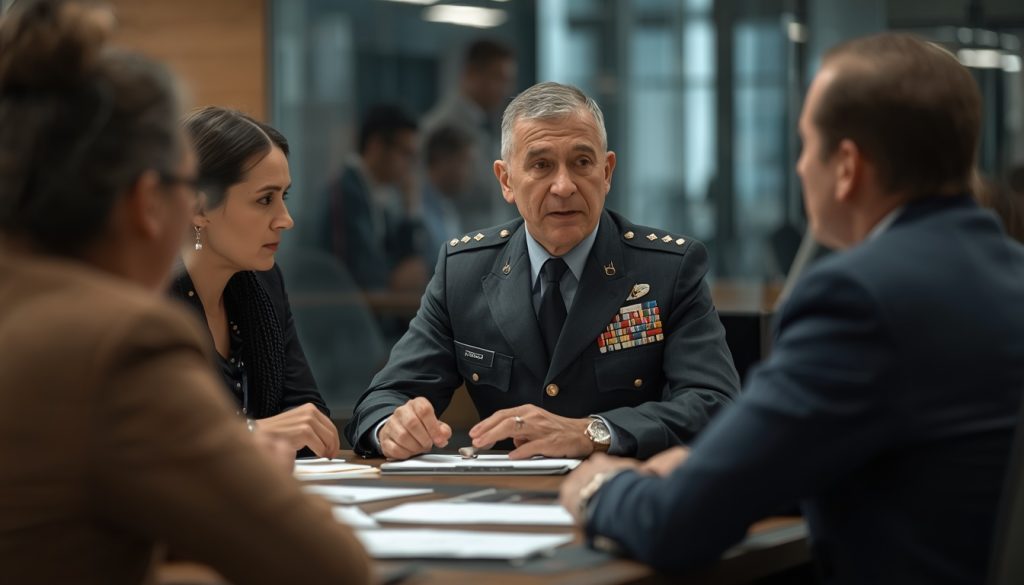
Battlefield Leadership
Veterans bring something to business leadership that is genuinely difficult to acquire any other way: the experience of making consequential decisions under conditions specifically designed to produce confusion, fatigue, and doubt — and then living with the outcomes of those decisions in ways that produced either the confirmation that the judgment was sound or the lesson that made the next call better.
This is not a statement about courage or patriotism, though both are real. It is a statement about a specific and transferable set of capabilities that military service develops in ways that most civilian career paths do not — capabilities that translate directly to some of the hardest problems business leaders face, particularly in the domains of risk management, organizational resilience, and decision-making under pressure.
The value of veterans in business leadership is frequently framed in terms of general qualities: discipline, work ethic, commitment, leadership. These are real, but they are also generic enough to be nearly meaningless as a differentiator. The more specific argument — the one that holds up when you examine it — is about three capabilities that battlefield leadership specifically develops and that organizations specifically need.
The After-Action Review Culture
One of the most distinctive and transferable organizational practices that military service develops is the after-action review: the structured, systematic examination of what happened in an operation, what was intended to happen, why the two differed, and what should be carried forward or changed.
The after-action review is not a performance evaluation. It does not assign blame. It does not protect the person who made a decision from scrutiny of that decision. It is a deliberately structured process for extracting learning from experience — the good decisions and the bad ones, the things that worked as intended and the things that failed — with the specific goal of improving the next operation. Senior leaders’ decisions are examined alongside junior leaders’ decisions. The standard is not “were you senior enough to be deferred to” but “was this the right call, and what can we learn from it.”
This culture produces something that most business organizations explicitly say they want and very rarely actually build: a genuine organizational learning cycle, in which the experience of doing the work is systematically converted into improved capability for doing it better. Business organizations that attempt something similar tend to produce the dysfunction version — the lessons-learned document that nobody reads, the retrospective that becomes an exercise in explaining why the problems that happened were actually fine, the post-mortem that turns into an accountability exercise rather than a learning one.
The veteran who has spent years in a genuine after-action review culture brings a specific and valuable organizational instinct: the habit of separating the quality of a decision from its outcome, the ability to examine their own and others’ judgment honestly without the ego defensiveness that makes most organizational learning exercises superficial, and the expectation that the organization has both the obligation and the capability to get better from its mistakes rather than minimizing or managing around them.
In security environments, this capability is particularly valuable. Security programs that develop genuine after-action capability — that examine the real sequence of events after an incident with the specific goal of improving detection, response, and prevention — consistently outperform programs that treat each incident as an isolated event to be resolved and moved past. The organizational learning loop is what separates a security program that improves over time from one that responds to the same category of incident repeatedly without the structural changes that would prevent the next one.
The after-action culture also addresses one of the most persistent organizational blind spots in security: the tendency to treat near-misses as non-events. A near-miss in a military operational context is examined with the same rigor as a failure, because the fact that it did not result in a bad outcome this time is not evidence that the underlying conditions were acceptable. The organization that conducts rigorous after-action review of its near-misses — the intrusion that was detected before significant damage, the compliance gap that was found before the audit, the vulnerability that was identified before it was exploited — builds a security posture that continuously improves through real operational experience rather than only responding after real operational failure.
The Mission First, People Always Principle
Veterans who have led people in difficult circumstances have been taught a principle that sounds paradoxical until you understand what it means in practice: mission first, people always. These are not competing priorities. They are the two non-negotiable commitments that define what good leadership looks like in an environment where both matter enormously.
Mission first means the purpose of the organization is not optional. The objective is not adjusted to accommodate the comfort or preference of the team. Standards are maintained because the mission depends on them, not because maintaining standards is convenient. The hardest conversations — the ones about performance, about commitment, about whether someone is serving the mission or serving themselves — get had because not having them is a failure of leadership, not because they are easy.
People always means those conversations are had with genuine care for the person. The team member who is not meeting the standard is not written off — they are engaged, developed, held accountable with the intention of helping them meet it. The team’s wellbeing is not a secondary consideration after mission accomplishment. It is an operational requirement, because a team that is not cared for does not perform at the level the mission requires.
Most business leadership culture splits these. Organizations talk about performance culture as if caring about people compromises standards, and they talk about people-centered culture as if maintaining high standards compromises care. Veterans who have led in operational environments have spent years learning that you cannot actually do one without the other, because the mission fails when the people are not genuinely invested in it, and the people become genuinely invested only when they trust that the organization is genuinely invested in them.
Structured Adaptability
The third capability that battlefield leadership specifically develops is what might be called structured adaptability: the ability to maintain disciplined process while being genuinely responsive to conditions that change faster than plans can track.
Military operational culture places enormous value on planning. The preparation is thorough, the contingencies are mapped, the decision points are identified in advance. And then the operation begins, and almost immediately the plan encounters reality in ways the plan did not anticipate. The leader who is rigidly committed to the plan fails. The leader who abandons discipline in favor of improvisation also fails. The leader who succeeds is the one who can hold the structured framework — the intent, the principles, the decision-making criteria — while adapting the execution to what is actually happening.
This is not a common capability in business leadership. Business plans are treated as commitments rather than frameworks. The deviation from plan is often experienced as failure rather than as the appropriate response to new information. The leader who says “the plan was wrong and here is what we are doing instead” frequently faces organizational resistance that has nothing to do with whether the new direction is correct.
Veterans who have learned to hold structure and adaptability simultaneously — who can abandon the plan’s specifics while maintaining the plan’s intent — bring a capability that organizations specifically need when they are facing the kind of rapid environmental change that outpaces planning cycles. The principle of structured adaptability is directly applicable to security and technology environments, where the threat landscape evolves faster than security programs can be redesigned and where the leaders who thrive are the ones who can maintain disciplined process while genuinely adapting to what is actually in front of them.
What Organizations Should Actually Value
The argument for veterans in business is sometimes made in the language of obligation or gratitude — hiring veterans because they served and they deserve opportunity. This is a legitimate value, and it is one that many organizations sincerely hold.
The better argument, from a purely organizational performance standpoint, is that veterans have been developed in specific ways that most civilian career paths do not produce, and those development outcomes are directly relevant to the hardest problems organizations face. The comfort with incomplete information. The integration of mission discipline and genuine people investment. The structured adaptability that holds intent while adjusting execution.
These capabilities were not accidental. They are the product of institutions that have spent centuries learning how to develop leaders for the hardest conditions, and they are transferable to organizational contexts that share those conditions — which is to say, most serious business environments operating in dynamic, high-stakes, consequence-bearing situations.
The Organizational Resilience Architecture
There is a fourth capability that military service develops that is worth naming separately, because it operates at the organizational level rather than the individual level: the ability to build organizations that are genuinely resilient rather than merely functional under normal conditions.
Military units operate with the explicit assumption that normal conditions will not persist. The leader who is the designated decision-maker may not be available. The communications channel that was planned may not function. The resource that was provisioned may not arrive. The plan that was carefully constructed will encounter reality within the first minutes of execution and will require adaptation. The organization has to be built to continue functioning when any or all of these things are true, because in operational environments they frequently are.
This produces a set of organizational design instincts that translate directly to business: deep redundancy in critical knowledge and decision capability, so that no single person’s absence creates a functional gap that cannot be covered; explicit training for the next person in the decision chain, so that leadership continuity does not depend on the top of the hierarchy remaining intact; and the deliberate development of the ability to improvise within doctrine — to make good decisions in novel situations by applying clear principles rather than following procedures that were designed for situations the current one does not resemble.
Most business organizations are not designed this way. They are designed for normal conditions, with limited planning for abnormal ones. The resilience that military organizations build into their structure by default is something business organizations typically build only after a disruption forces them to.
Veterans who have spent time designing and leading organizations under these constraints bring a specific and underutilized perspective to business organizational design. They have direct, practical experience with the questions that business leaders encounter when something goes wrong and the normal structures are not working as designed: how do you maintain decision continuity when the primary decision-maker is unavailable? How do you ensure that the team can execute against the intent when the plan has been overtaken by events and specific instruction is not coming? How do you preserve institutional knowledge in an environment where turnover is structurally high? How do you build a team that can adapt to genuinely novel situations without waiting for direction from above?
The Security and Technology Parallel
In security and technology environments specifically, the capabilities that battlefield leadership develops are not abstract analogues to what the work requires. They are nearly direct equivalents.
The security incident that develops at 2am is not waiting for the decision process to complete. The threat actor who has been in the environment for three weeks has not paused while the organization evaluates whether it has enough information to act. The compliance audit that surfaces an unexpected gap does not reschedule itself to accommodate the team’s bandwidth.
These are the conditions that operational military environments produce by design, and the leaders who have been developed in those environments have the specific capability for the work: the comfort with acting on incomplete information, the integration of mission discipline and genuine care for the people doing the work, the structured adaptability that holds intent while adjusting execution, and the organizational design instinct that builds resilience rather than assuming continuity.
The organizations that recognize this are the ones that approach hiring for security and technology leadership by thinking carefully about what those roles actually require in practice — the conditions they operate under, the decisions they demand, the kind of judgment they depend on — rather than by defaulting to what the job description conventionally specifies. When the requirement is genuine judgment under pressure in high-stakes, fast-moving, adversarially complex environments, the people who have been specifically developed for exactly those conditions represent a capability that the conventional hiring process consistently undervalues.
What to Look For
The practical implication for organizations evaluating veteran candidates for security, technology, and risk leadership roles is to reorient the evaluation toward the specific capabilities the environment requires.
Not “do they have the certifications” — though credentials matter. But more specifically: how do they describe making decisions when the information was insufficient and the window was real? How do they talk about the relationship between maintaining high standards and genuinely caring for the people those standards apply to? When have they had to hold a clear intent while adapting the execution completely — and what did that look like in practice?
The answers to these questions reveal whether the military experience produced the capabilities that transfer, or whether it produced a well-disciplined follower of procedure. Both are outcomes of military service. Only the former produces what the most challenging business environments actually need.
The Transfer That Happens in Practice
The organizations that have integrated veterans into security, technology, and risk leadership roles most successfully tend to describe the same pattern: the veteran’s most significant contribution was not in the technical domain — it was in the way they changed how the team responded to pressure.
The calibrated confidence in the face of genuinely incomplete information. The willingness to make the call, be accountable for it, and update when the evidence moves against the original assessment. The refusal to let the perfect picture become the enemy of the necessary action, especially when the window in which the action would be most effective is closing. These behavioral qualities, which military leadership specifically develops, change the operating culture of the teams they lead. The team that was previously paralyzed by uncertainty gradually learns that acting on the best available assessment is not reckless — it is responsible. The team that was previously protective of its assessments, hedging every recommendation to avoid being wrong, gradually learns that honest, provisional judgment is more useful than careful judgment that arrives after the window has closed.
This cultural transfer is the longest-lasting contribution veterans often make to the organizations they join. The specific technical knowledge they bring is valuable and often significant. The way they change how the team handles pressure is transformational in a way that is harder to hire for and harder to replicate through any other development path. And it is transformational in exactly the domain where security and risk organizations most need transformation: the capacity to respond well when conditions are genuinely difficult, genuinely ambiguous, and genuinely consequential.
Tom Glover is Chief Revenue Officer at Responsive Technology Partners, specializing in cybersecurity and risk management. With over 35 years of experience helping organizations navigate the complex intersection of technology and risk, Tom provides practical insights for business leaders facing today’s security challenges.
Eliminate All IT Worries Today!
Do you feel unsafe with your current security system? Are you spending way too much money on business technology? Set up a free 10-minute call today to discuss solutions for your business.